



How is Squamous Cell Carcinoma Diagnosed?
Squamous Cell Carcinoma (SCC) is one of the most common types of skin cancer, developing from the squamous cells that make up the outer layer of the skin. Although it is highly treatable when detected early, timely diagnosis is essential to prevent local tissue damage or spread. At Rolling Hills Dermatology Group and Seal Beach Dermatology Group, evaluation and treatment of skin cancers, including SCC, are performed under the expertise of Howard Fein, MD, a board-certified dermatologist with extensive experience in skin cancer diagnosis, surgical dermatology, and advanced treatment techniques. For more information, contact us or schedule an appointment online. We have convenient locations in Rolling Hills Estate CA, and Seal Beach CA.
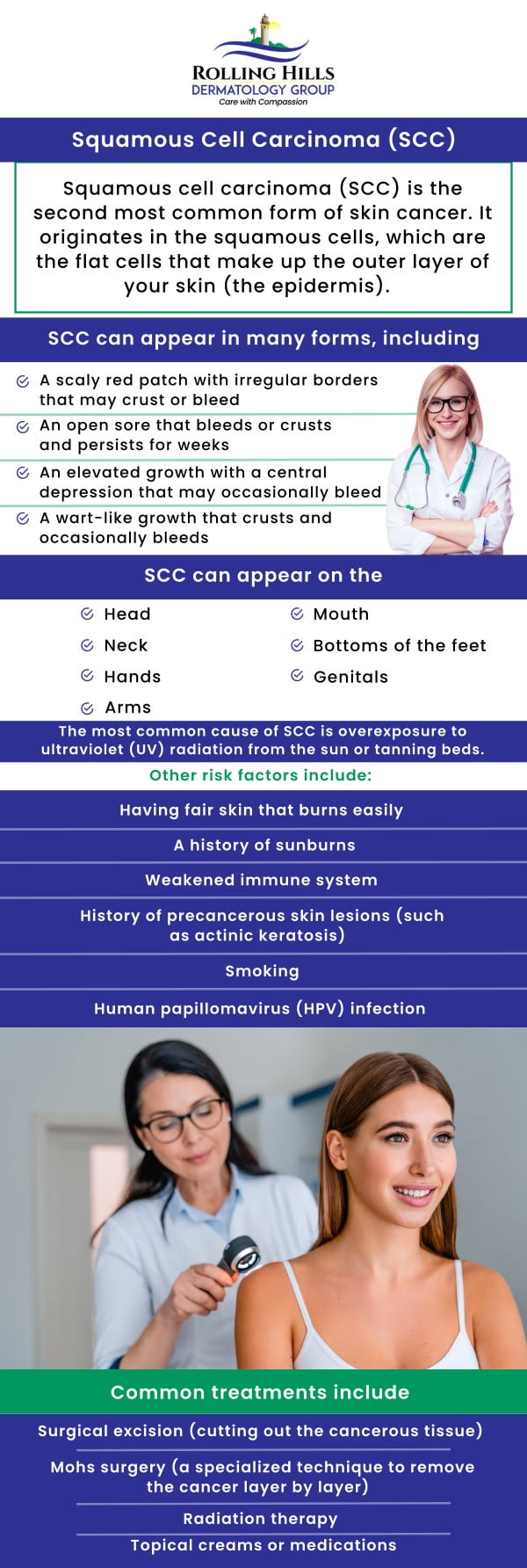
Table of Contents:
What does Squamous Cell Carcinoma (SCC) typically look like compared to a normal mole or a wart?
Is Squamous Cell Carcinoma considered a life-threatening form of skin cancer if caught early?
What are the primary risk factors for developing SCC, and can it appear on non-sun-exposed skin?
How can I perform a proper skin self-exam to spot suspicious lesions between dermatologist visits?
Will my treatment plan be managed by a board-certified dermatologist?
Understanding the importance of early diagnosis
Squamous Cell Carcinoma often looks different from common benign skin growths, although early lesions can sometimes be mistaken for harmless conditions such as warts, scabs, or irritated moles.
Typical characteristics of SCC may include:
● A rough, scaly red patch
● A firm or raised bump
● A crusted or bleeding sore that does not heal
● Thickened or wart-like growths
● Open sores that repeatedly heal and return
Unlike normal moles, which are usually smooth, evenly colored, and stable over time, SCC lesions tend to grow progressively and may become tender, itchy, or prone to bleeding.
Warts often maintain a consistent appearance, whereas SCC commonly changes in size, texture, or thickness over weeks or months. Some lesions may develop a central depression or ulceration, particularly in sun-exposed areas such as the face, ears, scalp, neck, and hands.
At Rolling Hills Dermatology Group, Howard Fein, MD, performs detailed clinical examinations using dermatoscopic evaluation to distinguish suspicious lesions from benign skin conditions before confirming diagnosis through biopsy when necessary.
When detected early, Squamous Cell Carcinoma is highly treatable and rarely life-threatening. Most cases can be successfully managed with minimally invasive procedures when diagnosed before deeper tissue involvement occurs.
However, SCC should never be ignored. If left untreated, the cancer may:
● Grow deeper into the surrounding tissue
● Damage nerves or underlying structures
● Spread to nearby lymph nodes
● In rare cases, metastasize to distant organs
Early intervention dramatically reduces these risks. Studies show that localized SCC treated promptly has an excellent cure rate.
Howard Fein, MD, emphasizes early detection through routine skin screenings because treatment is typically simpler, recovery is faster, and cosmetic outcomes are significantly improved when SCC is addressed in its earliest stages.
The most significant risk factor for SCC is cumulative ultraviolet (UV) exposure, including both natural sunlight and tanning beds. Long-term sun damage alters DNA within skin cells, increasing cancer risk over time.
Common risk factors include:
● Chronic sun exposure
● Fair or light skin tone
● History of sunburns
● Outdoor occupations or hobbies
● Increasing age
● Weakened immune system
● Previous skin cancer diagnosis
Although SCC most frequently develops on sun-exposed areas, it can also appear on non-sun-exposed skin. Lesions may occur in areas affected by chronic inflammation, scars, burns, or long-standing wounds. In some cases, SCC can develop on the lips, inside the mouth, genital regions, or other protected areas.
Because SCC may arise in unexpected locations, comprehensive full-body examinations performed at Rolling Hills Dermatology Group allow Howard Fein, MD to detect suspicious changes that patients might otherwise overlook.
Regular skin self-exams play a critical role in early detection. Dermatologists recommend performing a self-check approximately once per month in a well-lit room using both a full-length mirror and a handheld mirror.
A thorough self-exam should include:
● Face, ears, scalp, and neck
● Chest, abdomen, and torso
● Arms, hands, and fingernails
● Back and buttocks
● Legs, feet, soles, and between toes
Patients should look for warning signs such as:
● New growths that persist beyond several weeks
● Scaly or rough patches
● Sores that bleed or fail to heal
● Rapidly enlarging bumps
● Changes in texture or thickness
A helpful guideline is the “ugly duckling sign”—any lesion that looks noticeably different from surrounding spots deserves evaluation.
Howard Fein, MD, encourages patients to photograph suspicious areas and monitor changes over time. Any lesion showing growth, bleeding, or recurring irritation should be examined promptly by a dermatologist.
Yes. Management of Squamous Cell Carcinoma at Rolling Hills Dermatology Group is directed by Howard Fein, MD, a board-certified dermatologist specializing in skin cancer treatment and dermatologic surgery.
After diagnosis is confirmed through biopsy, treatment planning is individualized based on:
● Tumor size and depth
● Location on the body
● Patient health history
● Risk of recurrence
Treatment options may include:
● Surgical excision
● Mohs micrographic surgery
● Cryotherapy for early lesions
● Topical or field therapies
● Advanced reconstruction when necessary
Board-certified dermatologic oversight ensures that cancer removal prioritizes both complete tumor clearance and optimal cosmetic outcomes. Continuous follow-up monitoring also helps detect recurrence or new skin cancers early.
Squamous Cell Carcinoma often develops gradually, which provides an important opportunity for early detection and successful treatment. Routine dermatologic screenings combined with monthly self-examinations significantly improve the likelihood of identifying cancer before complications arise.
At Rolling Hills Dermatology Group, patients benefit from comprehensive skin cancer care led by Howard Fein, MD, integrating advanced diagnostic tools with evidence-based treatment approaches.
Squamous Cell Carcinoma is a common but highly manageable skin cancer when diagnosed early. Recognizing suspicious skin changes, understanding personal risk factors, and maintaining regular dermatologist visits are essential steps in protecting long-term skin health.
If you notice a persistent scaly lesion, non-healing sore, or unusual skin growth, professional evaluation is critical. With expert diagnosis and treatment provided by Howard Fein, MD, at Rolling Hills Dermatology Group, patients receive personalized, board-certified care focused on early detection, effective treatment, and ongoing skin cancer prevention. For more details, contact us or book an appointment online. We serve patients from Rolling Hills Estate CA, Torrance CA, West Carson CA, Lomita CA, Palos Verdes Estates CA, Hermosa Beach CA, Manhattan Beach CA, Redondo Beach CA, Seal Beach CA, Rossmoor CA, Garden Grove CA, Stanton CA, Westminster CA, and surrounding areas.
Check Out Our 5 Star Reviews




 Send Text
 How May I Help You?